
Why Donating Stuff Today Is Different Than Before
- 02/27/2026
- Downsizing & Aged Care Clearance
- 3 mins read
In this second post about the process to sort and distribute unwanted items from a home, the focus is on donations.
At ClearSpace, “give it away, rather than throw it away” is our philosophy. This undoubtedly is what our clients request as well.
Donating items can make a significant difference to the lives of others. However, the process is not what it used to be.
Not so long ago, the main stream charities were a one-stop destination for all your unwanted items – they were far more willing to accept all sorts of items, often without checking their condition, as well as large volumes. But not anymore.
Covid, I believe, was one of the catalysts to this change. In not being able to travel or go out, a lot of people had, arguably, more money, and as a result they upgraded, bought new and replaced a lot of their household items. Small and large electrical appliances, clothes, shoes, handbags, linen, tools, camping gear, games, toys, sporting equipment………
But this meant needing to offload the unwanted items and the charities became overloaded with too much and unsuitable items and accordingly, changed their rules.
What’s happening as a result isn’t good. Often, I would drive past a charity store after closing time, especially at night, and there would be piles of items literally dumped on their door step. And it’s raining!
Donating items, to the better-known charities, from a deceased estate is far more involved and complex than when you have just a few items from your own home. Several factors can make it complicated.
The sheer volume is the first factor. Just this week, I filled a hire truck full of all sorts of items from a modest, 3 bedroom home. That ended up at many different locations. Unless you do the same, you’ll need to load the car up
several times and make many trips to your local charity. But beware, that one store will become wary and likely say you can’t continue to bring your items in.
Some charities offer free home collections but need to be booked up to 4 weeks in advance. And remember, they still have the right to reject your items on arrival and, because it’s run by volunteers, there’s always a chance the pick up may be rescheduled at short notice.
Others offer a free, delivery service through Australia Post. You pack the items, download a delivery label and drop off to Australia Post. But it’s tracked so staying anonymous isn’t possible.
The other challenge is finding the right charity who will accept your donations.
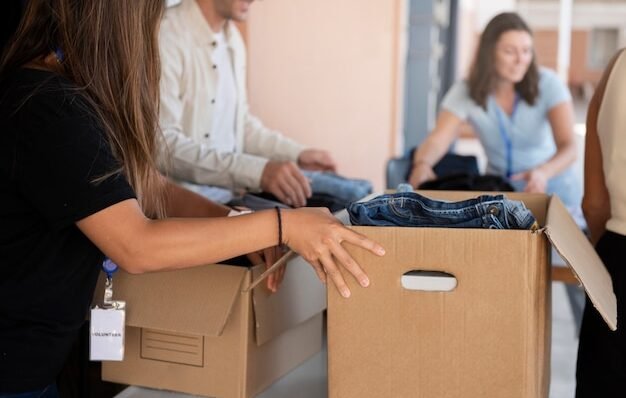
It’s not just a matter of getting a box and scooping everything in to it. It involves sorting and organising the items to ensure they are suitable. This process is time-consuming, especially when dealing with large quantities. And remember, you’ll likely have an attachment to the items which makes the job emotionally overwhelming.
Sorting through items, checking for damage and suitability requires dedication and effort. Without this, your donations are likely to be rejected only for you to be left with them.
If you plan well, sort appropriately, do your research, be ethical and are prepared to put in the time, it will be a fulfilling outcome for all involved.
If you don’t, the risk is you’ll go to a lot of effort for no one’s benefit – you or the charity.
Facebook and GumTree are options to give away your items, but these also have limitations. You’ll be forever responding to people who ask, “is it available” for any sort of ad that says “free”, but never follow through. Others are opportunistic and get your location for unethical or criminal purposes.
Alternatively, you could leave it all up to ClearSpace. Having been clearing homes for over 10 years, we have the systems, processes and knowledge and a large network of options to donate items, irrespective of the type or volume.
Be it to the well-known charities or others that have little public awareness or might be overseas.
Look out for my next post, where I’ll provide advice on how to deal with those awkward, unusual and dangerous items such as furniture, medicines, paint, oils & chemicals, tools & hardware, undonatable clothes & linen, medical products & aids, food, medicines and cleaning products.